Japanese Pokémon Cards: Real or Fake? Why Yours Looks Different (and Probably Isn't Fake)
A large share of the “is this fake?” posts that involve a Japanese card end the same way: the card is real. It just doesn't look like the English cards the owner is used to.
If you have a Japanese Pokémon card in your hand and something about it feels off (the back is wrong, the border is the wrong color, the rarity symbol is a letter, the text is smaller), the first thing to know is that all of those are how Japanese cards are supposed to look. This guide walks through what is normal for a Japanese print, so you can stop worrying about the differences that are by design and focus on the few that actually point to a counterfeit.
Japanese cards are a different product, not a copy
The Pokémon Trading Card Game started in Japan in 1996, and Japanese cards are printed by the same rights holders that produce English cards. Each market gets its own print run, on its own schedule, with its own layout conventions. The Japanese version of a card is not a translation of the English one; if anything it is the other way around, since Japanese sets usually release first.
That is why “compare it to my English cards” fails for Japanese cards. The differences you find are differences between two markets, not between a real card and a fake one. To check a Japanese card, you compare it against a known-real Japanese card.
Six differences that are completely normal
1. The back
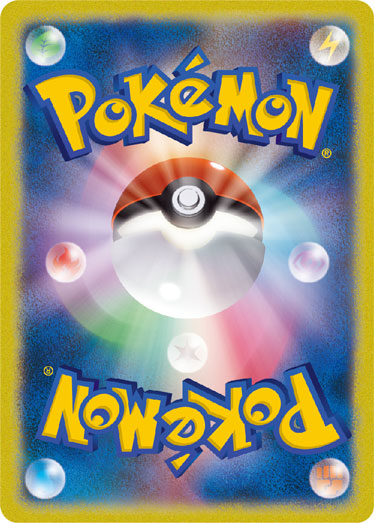

This is the difference that sends most people looking for a fake checker. The Japanese back is a rainbow burst around a central Poké Ball, with the Pokémon logo at the top and printed again, upside down, at the bottom, and small energy orbs in the corners. The English back is the blue swirl design. Both are official. What you check on a Japanese back is the same thing you check on an English one: the fine, even canvas texture and matte finish described in the card back guide. A glossy, smooth or blurry Japanese back is suspicious; a Japanese back that simply looks different from an English one is not.
2. The border
Japanese cards have used a silver borderon the front for many years. English cards had a yellow border for over two decades and only switched to silver with the Scarlet & Violet era in 2023, deliberately matching the Japanese look. So a silver-bordered Japanese card from an older era, sitting next to a yellow-bordered English card of the same Pokémon, is exactly what you should expect.
3. The rarity is a letter, not a symbol
English cards mark rarity with a symbol in the bottom corner: a circle for common, a diamond for uncommon, a star for rare. Japanese cards print letters instead: C, U, R for common, uncommon and rare, and then a ladder of higher rarities such as RR, RRR, SR, AR, SAR, UR and ACE depending on the era. A card with “SAR” printed in the corner is not a fake with a made-up symbol; it is a Special Art Rare, one of the most sought-after Japanese rarities.
4. The text, the fonts and the layout
Japanese typography is denser and the attack text sits differently in the box. HP, damage numbers and the collector number use the same conventions as English cards, but everything around them is set in Japanese type. Do not judge a Japanese card by whether its fonts “match” your English cards; judge it by whether the printing is crisp, with clean edges on every character, including the tiny copyright line at the bottom. Blurry, bold or uneven small text is a counterfeit tell in any language.
5. The holo pattern can differ
The same card can be printed with a different foil pattern in Japan and in the West, and some Japanese cards use textures that never made it to the English release. A holo pattern that does not match the English version of the card means nothing on its own. What matters is whether the foil looks like a printed layer integrated with the art (real) or a uniform glitter sheet laid over everything, text included (fake).
6. Print quality is often better
Collectors generally rate Japanese print runs as tighter: better centering, cleaner cuts, more consistent color. If your Japanese card looks too good next to your English ones, that is a point in its favor, not against it.
What still points to a fake on a Japanese card
Counterfeit Japanese cards exist, and the expensive ones (promos, Special Art Rares, older Charizard prints) are the usual targets. They fail the same checks as fake English cards:
- A smooth or glossy back. The rainbow-burst design is easy to copy; the canvas texture of the card stock is not. Tilt it under a lamp: a hard, mirror-like reflection is wrong.
- Wrong dimensions. Japanese and English cards are the same standard size. A card that does not stack flush with the rest of your collection is a problem in any language.
- Soft or wrong small print. The copyright line and the collector number at the bottom are printed small and sharp on real cards. Fakes often get them bold, blurry or with the wrong text. The footer guide covers what to look for.
- A card that does not exist. Every real Japanese card is in the public card databases, with its set, number and rarity. A Special Art Rare with a number that does not exist in its set, or a rarity the set never had, is a fabrication.
- Color that is off in the wrong way. Oversaturated art, a washed-out or greenish blue on the back, or a border that reads gold instead of silver.
Everything on this list is a print-quality or existence problem, not a “does it match my English card” problem. That distinction is the whole guide.
Other languages you might run into
Japanese is not the only non-English print. Pokémon cards are officially released in a range of languages, including Korean, Simplified and Traditional Chinese, Thai and Indonesian, on top of the Western-language runs (French, German, Italian, Spanish, Portuguese and more). The Western-language cards share the English back and layout; the Asian-language prints have their own conventions, closer to the Japanese ones. The rule is the same for all of them: compare against a known-real card from the same market, and check the print quality, not the resemblance to English.
The one-minute version
- Rainbow-burst back with the mirrored logo? Normal for Japanese.
- Silver border on an old card? Normal for Japanese.
- Letters instead of a rarity symbol? Normal for Japanese.
- Now do the real checks: back texture, sharpness of the small print, holo integrated with the art, the card exists in a database.
- Still unsure? Run it through the eight checks or upload it below.
FAQ
Are Japanese Pokémon cards official?
Yes. Japan is where the game started, and Japanese cards are printed by the same rights holders as English ones. The Japanese print of a card is just as authentic as the English print. The two are different products, not a real one and a copy.
Why is the back of my Japanese card different?
Because Japanese cards use their own back design: a Poké Ball in the middle of a rainbow burst, with the Pokémon logo printed at the top and again upside down at the bottom. English cards use a different back. Neither is a sign of a fake; each market has its own.
Why does my Japanese card have a letter like R, RR or SAR instead of a star?
Japanese cards print the rarity as letters in the bottom corner (C, U, R, RR, RRR, SR, AR, SAR, UR and so on), where English cards use a circle, diamond or star symbol. It is one of the most common reasons people think a genuine Japanese card is fake.
Can Japanese Pokémon cards be fake too?
Yes, counterfeits of Japanese cards exist, especially of high-value promos and Special Art Rares. They fail the same checks as fake English cards: the back texture, the typography, the holo pattern and the copyright line. The difference is that you have to compare against a real Japanese card, not an English one.
Keep reading
- How to Tell if a Pokémon Card Is Fake: The 8 Checks That Actually WorkBack texture, typography, holo pattern, copyright line and more — every check collectors use, ranked by reliability.
- The Pokémon Card Light Test: How It Works, and When It Lies to YouThe most famous DIY check, done properly — plus the failure cases nobody tells you about.
- Real vs Fake Pokémon Card Backs: The Texture TellThe back of the card is where counterfeits go to die: the canvas texture, the three mistakes fakes make, and how to photograph it.
- I Thought My Pokémon Packs Were Fake: What I Checked (A True Story)Two kiosk packs, pulls that were too good, and a night of spiraling — everything I checked, including the wrapper tells almost nobody covers.
- Is Grading Worth It? PSA/CGC vs a Quick Authenticity CheckGrading costs $15–50 a card and takes months; a quick check takes 30 seconds. When each is the right call, and the order to use them in.
- How to Spot Fake Pokémon Cards on eBay (Before You Buy)You can't hold the card, so you read the listing instead — price, photos, wording, seller — and check the seller's own photos before you bid.
- Fake PSA Slabs Exist: How to Verify a Graded Pokémon Card in One MinuteThe card inside a real slab is already authenticated, so scammers fake the slab. The free one-minute cert check, and what to do when it fails.
- How to Read a Pokémon Card's Copyright Line, Set Symbol and NumberThe footer of the card is a fingerprint: copyright line, set symbol, card number, rarity, regulation mark. What each one means and where fakes slip up.
- Fake or Resealed? How to Check a Pokémon Booster Box or Pack Before You Open ItCounterfeit packs fail on print, resealed ones on seams. The shrink wrap, crimp and price checks for sealed product, before and after you open it.
- Misprint or Fake? How to Tell a Real Pokémon Error CardJudge everything the error didn't touch: a real misprint has a perfect back, fonts and footer. The factory error patterns, and the fakes sold as rare errors.
TCG Verdict provides an advisory opinion based on photos, with an explicit confidence level. It does not replace a physical inspection or professional grading (PSA/CGC). Pokémon is a trademark of its respective owners; TCG Verdict is not affiliated with, or sponsored by, Nintendo or The Pokémon Company.